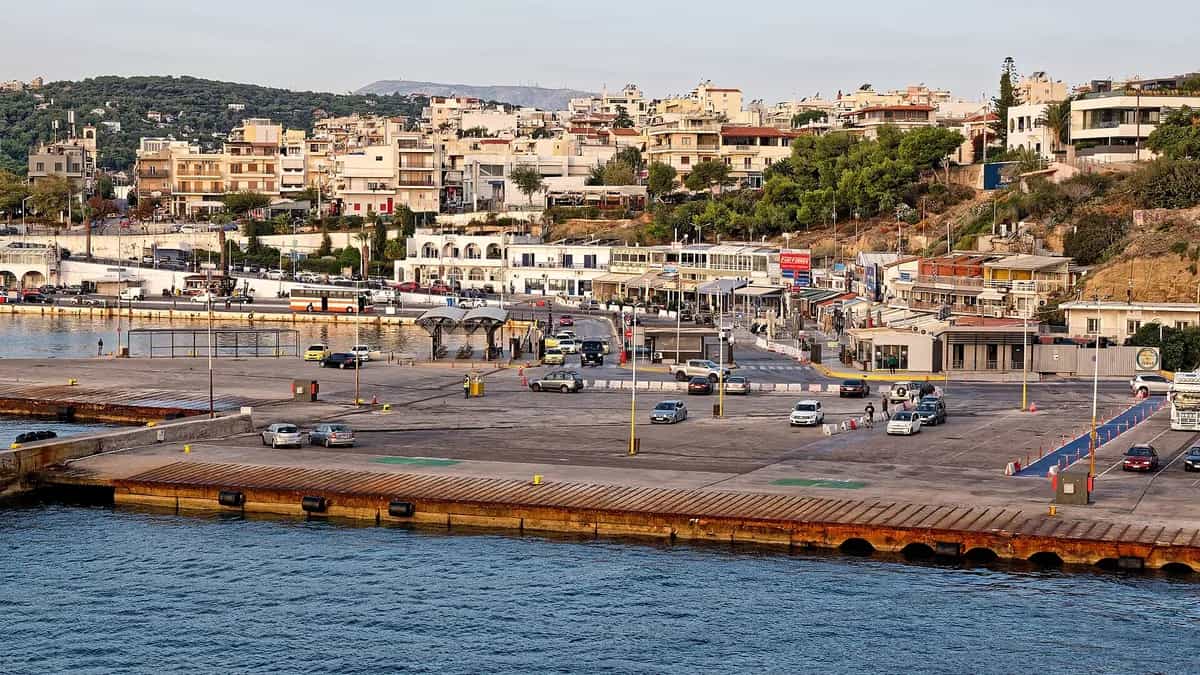
Updated:
Most people travelling from Athens to Mykonos by air face the same decision in the arrivals hall: the ferry from Rafina, the ferry from Piraeus, or a second flight. The three do not compete on the same terms. Rafina is the closest port to Athens Airport and has the shortest crossings. Piraeus is the big port with the most sailings and a metro line from the airport. The flight is 40 minutes in the air and turns the whole day around. This guide gives the times and prices in force in September 2026, a table of the earliest realistic ferry for each landing time at Athens, and the situations in which each option is the right one. It is the mirror of our Mykonos to Athens page, written for the busier direction.
Checked on 22 September 2026 against operator schedules aggregated by Ferryhopper for the Rafina to Mykonos and Piraeus to Mykonos routes, the Athens public transport fares published by OASA, the KTEL Attikis airport to Rafina service, and the Fraport Greece announcements for Mykonos Airport. Ferry and flight times change with the season and are not repeated here; look them up for your date and apply the buffers below.
Athens to Mykonos: the three options side by side
| Ferry from Rafina | Ferry from Piraeus | Flight ATH → JMK | |
|---|---|---|---|
| Airport to departure point | KTEL Attikis bus, €4 paid on board, roughly hourly, 40 to 60 min; taxi 30 to 40 min | Metro line 3 direct, €9 airport ticket, about 65 min; X96 bus €5.50, 24 h, 90 to 120 min | None; stay in the terminal (Schengen entry and bag re-check if on separate tickets) |
| Crossing / flight time | 2 h 05 to 2 h 30 high-speed; 3 h 45 to 4 h 40 conventional | 2 h 40 to 2 h 50 high-speed; 4 h to 5 h 50 conventional | About 40 min in the air |
| Operators | Fast Ferries, Golden Star Ferries, Seajets | Blue Star Ferries, Seajets | Aegean / Olympic Air, Sky Express |
| Frequency | Year-round; up to 10 sailings a day in summer | Year-round, daily; conventional every day, high-speed mainly in season | Several a day, year-round; the only winter link |
| Fare, one way (Sept 2026) | From about €36 to €38 conventional, from about €53 high-speed | From about €43 to €53 conventional, from about €66 to €88 high-speed | Roughly €60 to €150 and more, higher in August; checked bags extra on most fares |
| Arrives at | New Port (Tourlos), 2 km from town | New Port (Tourlos) | Mykonos Airport, 4 km from town |
| Luggage | Free, generous | Free, generous | Airline limits; a bag can cost more than a ferry seat |
Ferry fares are the lowest "from" prices shown for the route in September 2026 and rise for peak dates, seats with a table and cabins; flight fares are the range we observed on the Athens to Mykonos route this year and are more volatile than the ferries. All three options land you on Mykonos; from the New Port a bus, taxi or transfer takes you on, as described in our New Port vs Old Port guide.
Getting out of Athens Airport first
Whichever ferry you choose, the first hour is the same and it is the part people underestimate. Athens Airport (ATH) is a large terminal, and a flight shown as landed still needs 15 to 20 minutes before you are in the baggage hall. With cabin bags only and a Schengen passport, 30 to 40 minutes from landing to the kerb is normal; checked bags add 20 to 30 minutes. If you arrive from the UK, the US or another non-Schengen country, you pass the Entry/Exit System check here, with fingerprints and a photo on first entry; since the congestion pauses expired on 6 September 2026 there is no switching it off when the queue builds, so budget 60 to 90 minutes from landing to the kerb in summer. Our EES guide explains the check; once through it you travel on to Mykonos as a domestic passenger, by ferry or by air, with no further passport control.
Option 1: Rafina, the closest port
The port of Rafina is a small harbour on the east coast of Attica, about 30 km from the airport and on the same side of Athens, which is why it is the natural choice from ATH. The KTEL Attikis bus runs from the stop outside the arrivals hall to Rafina port for €4 one way, paid to the driver, roughly hourly through the day; the ride is 40 to 60 minutes depending on traffic and it stops inside the port a short walk from the quays. Times shift by season, so check the operator's board on the day rather than a timetable saved months earlier. A taxi does the same run in 30 to 40 minutes on the meter, which for three or four people with bags is often the better buy.
Three companies sail from Rafina to Mykonos, all arriving at the New Port at Tourlos: Fast Ferries and Golden Star Ferries with conventional ships (3 h 45 to 4 h 40) and, in season, faster vessels around 2 h 20 to 2 h 30, and Seajets with high-speed catamarans from about 2 h 05. Conventional fares start around €36 to €38, Seajets around €53. In summer there are up to ten departures a day; in winter it falls to one or two conventional sailings, still daily. The weakness of Rafina is exposure to the meltemi: the strong northerly summer wind cancels high-speed sailings first, and on a windy day the conventional ship is the one that goes.
Option 2: Piraeus, the big port
Sitting on the opposite side of Athens from the airport, Piraeus is the other choice, and that is the trade-off: more sailings and the most predictable connection, but a longer run to get there. Metro line 3 goes directly from the airport station to Piraeus in about 65 minutes; the airport ticket is €9 (€4.50 reduced) and is valid on connecting buses for 90 minutes, so it also covers the short hop from the metro station to a far gate. The X96 express bus runs round the clock between the airport and the port for €5.50, stopping along the Piraeus waterfront, but takes 90 to 120 minutes off-peak and longer in summer traffic. A taxi takes 45 to 70 minutes depending on the ring road.
Two companies serve Piraeus to Mykonos year-round. Blue Star Ferries runs the conventional ships, 4 to 5 h 50 depending on how many islands the ship calls at on the way, from about €43 to €53; Seajets runs high-speeds of 2 h 40 to 2 h 50 from about €66 to €88, daily in the season and fewer days a week in winter. Choose Piraeus when you want a specific evening sailing to exist, when you are travelling with a car (space on the conventional ships sells out before seats do), or when the wind forecast is bad and you want the big ship rather than the catamaran.
Option 3: the flight
Aegean and its subsidiary Olympic Air, and Sky Express, fly Athens to Mykonos several times a day all year, about 40 minutes in the air. On paper it beats every ferry; in practice the door-to-door difference is smaller than it looks, because the connection needs its own buffer. On a single ticket (for example a European city to Mykonos via Athens on Aegean) the bags are checked through and the airline's minimum connection time applies, typically an hour or so. A non-Schengen arrival still clears EES in Athens on the way to the domestic gate. On separate tickets you must collect your bags, exit, check in again and re-clear security, and for a non-Schengen arrival in summer that is a three to four hour job, not a 90-minute one. If the inbound flight is late on separate tickets, the onward carrier owes you nothing; our delay compensation page explains where EU261 does and does not help.
Fares are the other variable: the flight ran roughly €60 to €150 one way this year, with August far above the low end, and a checked bag on a basic fare can cost as much as a conventional ferry seat. You arrive at Mykonos Airport, 4 km from town, with the same bus, taxi and transfer choices as any other arrival.
Landing at Athens → earliest realistic ferry
The windows below count from the scheduled landing time at ATH to the scheduled ferry departure and are the earliest you should book, not the earliest anyone has managed. They assume a Schengen arrival with checked bags; take 30 minutes off for cabin bags only and add 30 to 45 minutes for a non-Schengen arrival with the EES check. Be on the quay 30 minutes before a high-speed and 20 minutes before a conventional ship; with a vehicle, 60 minutes.
| Route | Landing → ferry, minimum | Example | Why |
|---|---|---|---|
| Rafina by taxi | 2 h 15 | Land 11:05 → 13:30 ferry is realistic; 12:20 is not | 60 min out of ATH, 40 min drive, 30 min at the port |
| Rafina by KTEL bus | 3 h | Land 11:05 → a 14:30 ferry is comfortable | Adds up to an hour's wait for the next bus and a slower ride |
| Piraeus by metro | 2 h 45 | Land 12:00 → 15:15 ferry works; 14:00 does not | 65 min metro plus the walk to the gate, trains roughly every half hour |
| Piraeus by X96 bus | 3 h 30 | Land 11:05 → afternoon sailing only | Traffic on the ring road is the variable you cannot control |
| Any ferry, landing after 15:00 in summer | Check whether an evening sailing exists for your date before you decide; if it does not, the flight or a night in Athens or Rafina is the answer. Nothing sails to Mykonos overnight. | ||
The same arithmetic runs in reverse for the flight: a non-Schengen landing at ATH on a separate ticket should not be paired with an onward Mykonos flight less than three hours later. The connection that most often goes wrong in travellers' accounts is the 90-minute self-transfer with checked bags; on a through ticket it is fine, on two tickets it is a gamble.
When each option wins
- Take the Rafina ferry when you land before early afternoon, travel with bags, and want the shortest total time at the lowest price: bus €4 plus a seat from €36 to €53, and you are on the quay at Tourlos within about five hours of landing.
- Take the Piraeus ferry when you need a later departure, want the big ship in a meltemi forecast, are taking a car across, or are spending a night in central Athens first (Piraeus is 20 minutes from the centre by metro; Rafina is not).
- Take the flight when you land late, travel light, are on a single through ticket, or travel between November and March, when ferries thin out and the 40-minute hop is the island's lifeline. It is also the only option that makes a same-day arrival possible after a mid-afternoon landing in summer.
- Nobody wins by booking a non-refundable ferry inside the minimum windows above and hoping the inbound flight is early. Buy the ticket at the port or as an open-date ticket if the connection is tight; operators do not change tickets after the ship has sailed.
Two things to know for winter 2026/27
First, the season. From roughly November the direct international flights to Mykonos stop and the Athens flight becomes the way in by air, while the ferries drop to one or two daily conventional sailings from each port; our winter guide covers the island end. Second, and new: Fraport Greece has announced runway reconstruction at Mykonos Airport with all flights suspended for 24 hours every Thursday from 19 November 2026 to 18 March 2027 (except 22, 24 and 31 December and 5 and 7 January). On those Thursdays the ferry from Rafina or Piraeus is not one option among three; it is the only one. If you land at Athens on a Thursday in that window, plan the ferry or an overnight in Athens.
Whichever way you arrive, the last leg on Mykonos has its own timetable, and the bus stops at 22:15; for late arrivals on the island read our night arrival guide, and for the reverse connection, a Mykonos landing followed by a ferry the same day, the same-day guide.
Sources
Crossing times, operators, frequency and "from" fares for Rafina to Mykonos and Piraeus to Mykonos are as listed for September 2026 on Ferryhopper (Rafina) and Ferryhopper (Piraeus), which aggregate Fast Ferries, Golden Star Ferries, Seajets and Blue Star Ferries schedules; sailing times for a given date must be checked with the operator. Athens metro airport ticket (€9) and Airport Express bus (€5.50) fares are from OASA. The airport to Rafina bus is operated by KTEL Attikis (€4 one way at the time of checking; timetable seasonal). The Thursday runway closures of winter 2026/27 are from the announcement on the official Mykonos Airport site (Fraport Greece). Flight durations and fare ranges are from the Aegean, Olympic Air and Sky Express schedules observed on the Athens to Mykonos route in 2026. Cover photo: Rafina port from a departing ferry, Holger Uwe Schmitt, CC BY-SA 4.0, via Wikimedia Commons. All checked 22 September 2026.